

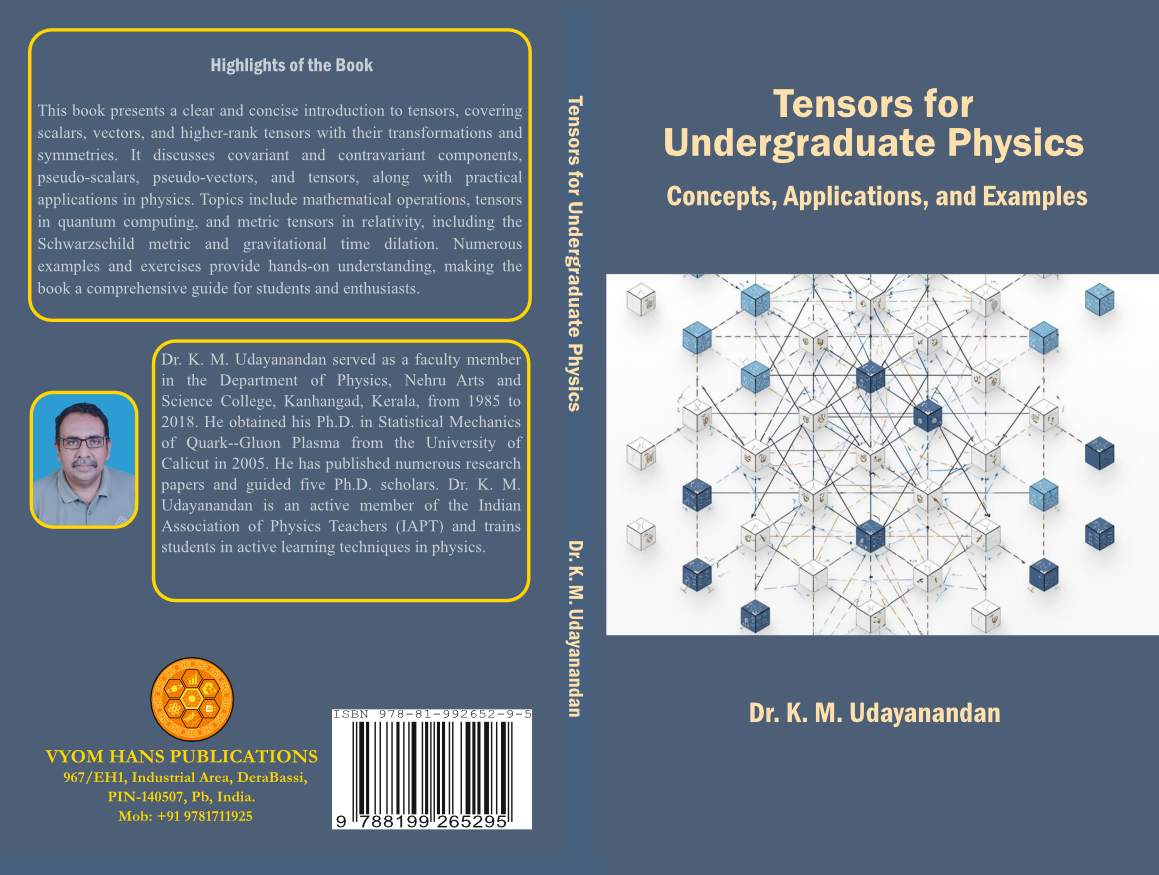
Tensors play a fundamental role in modern physics. From classical mechanics and electromagnetism to general relativity and quantum information theory, tensors provide the mathematical language needed to describe physical laws in a consistent and coordinate independent manner. Despite their importance, many undergraduate students encounter tensors through highly abstract and formal treatments that often make the subject appear difficult and inaccessible.
Thank you for reading this post, don't forget to subscribe!Paperback Book on Amazon: https://amzn.to/46XMkxO
Introducing Tensors for Undergraduates has been written with a different goal to make tensor concepts clear, intuitive, and physically meaningful for students beginning their journey into advanced physics.
Why Learn Tensors?
As physics progresses beyond introductory topics, vectors alone are no longer sufficient to describe many physical quantities. Stress, inertia, spacetime curvature, and electromagnetic fields naturally require tensor formulation. Understanding tensors allows students to move confidently toward advanced subjects such as:
- Classical Mechanics
- Electromagnetism
- General Relativity
- Quantum and Modern Physics
- Mathematical Physics
This book helps bridge the gap between elementary vector mathematics and the powerful tensor methods used in higher-level physics.
A Student-Friendly Approach
The book begins with familiar mathematical ideas such as scalars and vectors, gradually building toward:
- Second-rank and higher-rank tensors
- Tensor operations and notation
- Coordinate transformations
- Physical interpretation of tensor quantities
Rather than focusing purely on abstract definitions, each concept is supported by clear physical examples drawn from real applications in physics. This approach helps students understand not only how tensors work, but why they are essential.
Learning Through Applications
Special emphasis is placed on:
- Visual intuition and geometric understanding
- Component-based calculations useful in problem solving
- Connections between mathematical definitions and physical applications
Examples from mechanics, electromagnetism, and modern physics demonstrate how tensor methods naturally arise in real-world problems encountered during undergraduate studies.
Designed for Undergraduate Physics Students
Exercises and worked examples throughout the book reinforce conceptual understanding while developing analytical and problem-solving skills. The text is particularly suitable for:
- Undergraduate physics students
- Engineering students studying mathematical methods
- Self-learners preparing for advanced theoretical physics
- Students transitioning toward relativity or field theory
Ideal Resource for Physics Students
The structure and level of presentation align well with undergraduate physics curricula followed in UK universities, making the book a helpful companion for students seeking clearer conceptual foundations in mathematical physics.
Get the Book
You can explore the complete book here:
On Amazon:
Kindle Edition: https://amzn.to/4bdJ9ED
Paperback Amazon: https://amzn.to/46XMkxO